
PATENT ENFORCEMENT | DISPUTE RESOLUTION
Protect the Rights You Have Secured.
When patent rights are challenged or infringed, we assess the position, define the response and pursue a effective enforcement or resolution.
WHEN RIGHTS ARE CHALLENGED
A Patent Is Only as Effective as the Position Behind It
Effective enforcement begins with assessing strength of the rights and defining the commercial objectives.
Patent disputes demand more than a response to alleged infringement. The scope of protection, available evidence and commercial implications must be assessed before determining the appropriate course of action.
ASSESSING THE POSITION
Before Action, Establish the Ground.
Enforcement begins with assessing the patent, the conduct in question and the available evidence. This establishes the strength of the position and the options for action.
01
PATENT RIGHTS
Define the Protection
Review the relevant claims, status and ownership of the rights relied upon.
02
ALLEGED INFRINGEMENT
Examine the Conduct
Assess the relevant product, process or activity against the patent claims.
03
EVIDENCE
Build the Record
Identify and preserve the technical, commercial and documentary material supporting the position.
04
OBJECTIVE
Define the Outcome
Establish whether the priority is cessation, settlement, licensing, compensation or another commercial result.
The clearer the position at the outset, the more deliberate the response can be.
CHOOSING THE RESPONSE
Not Every Dispute Belongs in Court.
The appropriate response is shaped by the strength of the rights, the nature of the dispute and the commercial objective. Some matters call for early engagement; others demand formal action
The objective is not escalation for its own sake. It is the response that best serves the right and the commercial position.
BUILDING THE EVIDENCE
A Strong Position Must Be Proved.
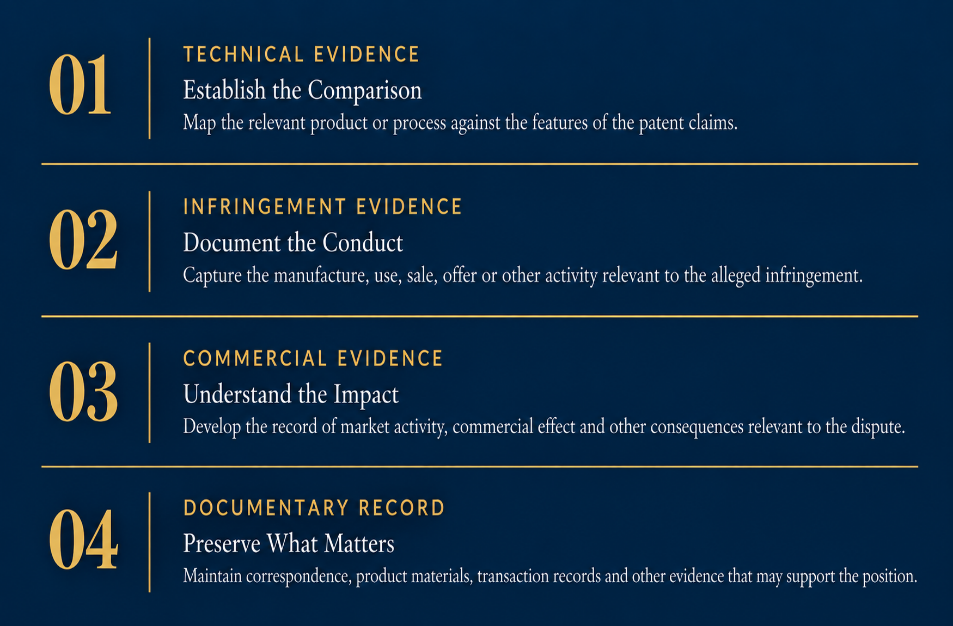
Patent enforcement depends on evidence. Technical comparisons, infringing conduct and commercial impact must be documented and assessed against the patent claims.
In patent disputes, the strength of the right and the strength of the evidence must work together.
RESOLVING THE DISPUTE
Resolution Does Not Always Mean Concession.
Patent disputes may be resolved through settlement, licensing or other negotiated outcomes where the terms protect the underlying commercial position.
The strongest resolution ends the dispute without losing sight of the right that gave rise to it.
01 SETTLEMENT
Define the Outcome
Structure terms that address the dispute while protecting the interests that matter beyond it.
02 LICENSING
Turn Conflict into Permission
Consider whether authorised use can provide a commercially workable alternative to continued enforcement.
03 UNDERTAKINGS
Set Clear Boundaries
Define commitments around future conduct where they form part of the resolution.
04 COMMERCIAL TERMS
Protect the Position
Address payment, future use and other terms necessary to make the resolution effective.
THROUGHOUT THE DISPUTE
Keep the Commercial Objective in View.
Patent disputes can become technically and procedurally complex. The strategy should remain anchored to what the business ultimately needs to protect or achieve.
BUSINESS PRIORITY
Know What Matters
Keep the technology, product, market or commercial relationship at the centre of the strategy.
PROPORTIONALITY
Match the Response
Consider the significance of the dispute against the cost, exposure and value of continued action.
FLEXIBILITY
Preserve the Options
Keep enforcement, negotiation and commercial resolution available as the dispute develops.
OUTCOME
Stay Focused on the End
Measure each step against the result the business is ultimately seeking.
A dispute strategy should protect more than the patent. It should protect the position the patent was intended to support.
Frequently Asked, Clearly Answered
01. What constitutes patent infringement?
Patent infringement generally arises where conduct falls within the scope of a patent claim without the required authorisation. The assessment depends on the patent, the conduct and the applicable law.
02. What should be assessed before taking enforcement action?
03. Does patent enforcement always require court proceedings?
04. Can the validity of a patent be challenged during a dispute?
Yes. An alleged infringer may challenge the validity of the patent relied upon, subject to the procedures available in the relevant jurisdiction.
05. What evidence is important in a patent infringement dispute?
Relevant evidence may include technical analysis, product or process information, market activity, correspondence, transaction records and other material connecting the alleged conduct to the patent claims.
06. Can a patent dispute be resolved through licensing?
Yes. Where commercially appropriate, the parties may resolve a dispute by agreeing terms under which continued use of the patented technology is authorised.
07. What remedies may be available for patent infringement?
Available remedies depend on the jurisdiction and circumstances and may include measures to restrain infringement, monetary relief and other forms of relief permitted under applicable law.
08. How are cross-border patent disputes handled?
Because patent rights are territorial, enforcement generally needs to be considered jurisdiction by jurisdiction while coordinating the wider strategy where related disputes arise across multiple markets.
Act with Clarity. Protect What Matters.
When patent rights are infringed, challenged or placed at risk, the response should be measured, evidence-led and commercially focused.