
FROM INVENTION TO APPLICATION
Patent Drafting & Filing
Structuring technical innovation into a clear, strategically framed patent application.
THE DRAFTING FOUNDATION
The Application Defines the Protection.
Strong patent protection begins with how the invention is drafted.
A patent application goes beyond describing an invention. It structures its technical features to define how it works and the protection sought.
ANATOMY OF THE APPLICATION
Every Part Has a Purpose.
A patent application brings technical detail, legal scope and supporting disclosure together in a structured form.
Each element supports the application. The claims define its protective reach.
01
DESCRIPTION
Explain the Invention
Sets out the invention, its technical context and how it works.
02
CLAIMS
Establish the features and combinations for which protection is sought.
Establish the features and combinations for which protection is sought.
03
DRAWINGS
Illustrate the Detail
Support the disclosure by visually presenting relevant technical features.
04
ABSTRACT
use the Invention
Provides a concise technical summary of the invention.
CLAIMING THE INVENTION
Protection is Defined in the Claims.
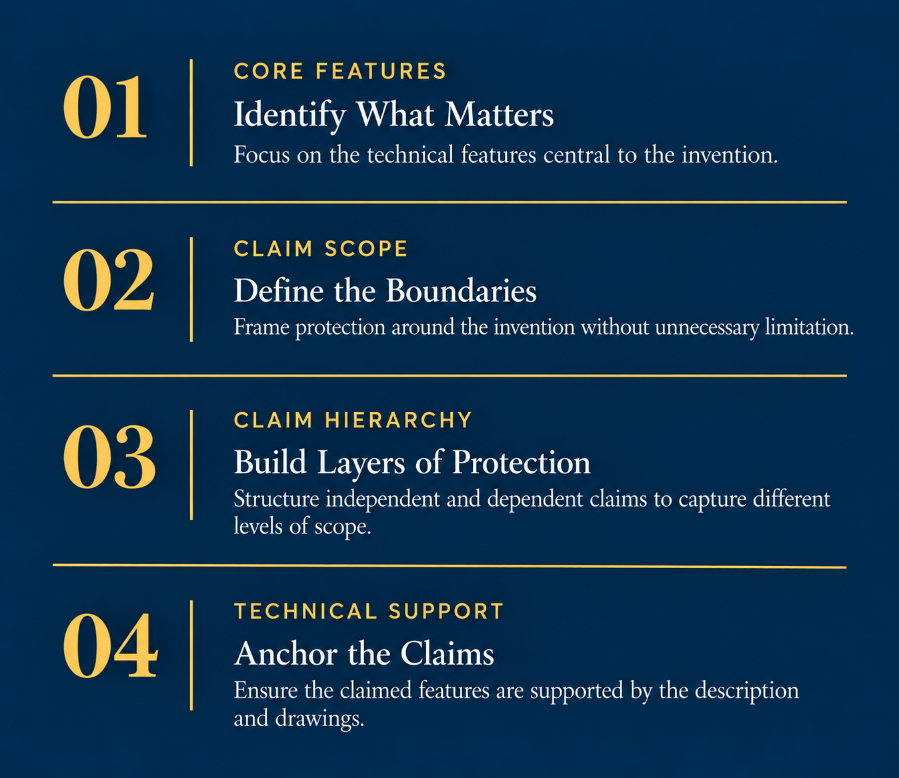
Claims translate the invention’s technical features into the boundaries of protection sought.
Effective claim drafting balances breadth, precision and technical support.
THE VALUE OF PRECISION
Small Drafting Choices Can Shape Protection.
The strength of a patent can depend on what is defined, disclosed and preserved at the drafting stage.
TOO NARROW
Protection Can Be Constrained
Unnecessary limitations may restrict the scope of protection sought.
TOO BROAD
Claims Can Face Objections
Overreaching claims may create difficulties during examination.
INSUFFICIENT SUPPORT
Options Can Be Lost
Missing technical detail may limit the ability to support or refine claims later.
UNCLEAR LANGUAGE
Scope Can Become Uncertain
Ambiguity can weaken the clarity and effectiveness of the protection sought.
Precision in drafting protects options before they are lost.
FROM DRAFT TO FILING
Filing is a Strategic Decision.
Where, when and how an application is filed can shape the path of patent protection.
A well-drafted application needs an equally considered filing strategy.
01
FILING ROUTE
Choose the Path
Determine the appropriate national, regional or international filing route.
02
PRIORITY
Secure the Filing Date
Establish priority and preserve the basis for subsequent filings.
03
JURISDICTIONS
Plan the Markets
Align filing decisions with commercial markets and protection priorities.
04
FILING REQUIREMENT
Prepare for Submission
Coordinate the documents, formalities and technical materials required for filing.
BEFORE SUBMISSION
Ready for Filing.
Before submission, the application is reviewed as a whole to ensure the technical disclosure, claims and filing materials work together.
Precision before filing reduces uncertainty after submission.
AFTER FILING
Filing is the Beginning, Not the End.
Once filed, the application enters examination, where formalities, objections and deadlines shape its path towards grant.
APPLICATION FORMALITIES
Complete the Filing Record
Address filing formalities and any outstanding documentation required by the patent office.
EXAMINATION
TOO BROAD
Claims Can Face Ojections
Overreaching claims may create difficulties during examination
CLAIM AMENDMENTS
Refine Where Required
Adjust claim language where appropriate while preserving the commercial value of the protection sought.
GRANT PATH
A carefully drafted application creates the foundation for what follows after filing.
BUILT FOR WHAT FOLLOWS
Draft with the Future in Mind.
Strong patent drafting anticipates how the invention may evolve, where protection may extend and what commercial value must be preserved.
01 FUTURE DEVELOPMENTS
Leave Room to Evolve
Build sufficient technical depth around variations and embodiments of the invention.
02 INTERNATIONAL FILING
Prepare for Wider Protection
Structure the application with potential foreign and international filings in view.
03 COMMERCIAL SCOPE
Protect What Matters
Align the drafting with the technical features carrying commercial significance.
04 ENFORCEABLE POSITION
Think Beyond Grant
Draft with clarity and precision to support the long-term value and enforceability of the patent.
Frequently Asked, Clearly Answered
01. What information is needed to draft a patent application?
Typically, the drafting process begins with details of the invention, how it works, its technical features, the problem it addresses, known alternatives and any drawings, prototypes or supporting technical material available.
02. Do I need a working prototype before filing a patent application?
Not necessarily. A prototype is generally not required, but the invention should be developed sufficiently to allow it to be described clearly and in enough technical detail to support the protection sought.
03. What is the difference between the description and the patent claims?
The description explains the invention and provides its technical disclosure. The claims define the specific subject matter for which patent protection is sought.
04. Can I add new technical features after the patent application has been filed?
New subject matter generally cannot simply be added to an existing application after filing. This makes it important to capture relevant features, variations and embodiments when preparing the initial application.
05. Should a patentability search be completed before drafting?
A patentability search is not always mandatory, but it can help identify relevant prior art and inform how the invention and its distinguishing features are approached during drafting.
06. Can one patent application cover different versions of an invention?
Potentially. Different embodiments, variations and implementations may be included where they are appropriately connected and supported by the disclosure, although applicable patent requirements must also be considered.
07. Can the same patent application be filed in multiple countries?
Patent rights are territorial. Protection in multiple jurisdictions generally requires a filing strategy involving national, regional or international routes, often relying on an earlier application for priority where applicable.
08. What happens after a patent application is filed?
The application proceeds through the relevant patent-office process, which may include formalities review, publication, substantive examination, responses to objections and amendments before a decision on grant.
09. How long does the patent filing process take?
The time required varies considerably by jurisdiction, filing route, technology and the examination process. Filing itself may be completed relatively quickly once the application is ready, while examination and grant can take substantially longer.
10. Can an invention be disclosed before the patent application is filed?
Public disclosure before filing can affect patentability in many jurisdictions. Where possible, filing should be considered before publishing, presenting, selling or otherwise publicly disclosing the invention.
Turn Your Invention into a Patent Application
Move from technical concept to a precisely drafted, filing-ready patent application.