
DESIGN RIGHTS ACROSS BORDERS
International Design Registration
Protect distinctive designs across international markets through a coordinated filing & registration strategy.
PROTECTION BEYOND ONE MARKET
Design Rights Stop at the Border
Commercial reach may be global. Design rights remain territorial.
A design protected in one jurisdiction does not automatically enjoy protection elsewhere. As products enter new markets, their design protection must extend accordingly.
Effective international protection begins with identifying where products will be launched, manufactured, sold, licensed or exposed to competition.
WHERE PROTECTION MATTERS
Not Every Market Carries the Same Value
International protection is not about filing everywhere. It is about protecting the design where commercial value, exposure and future opportunity are greatest.
CORE MARKETS
Prioritise jurisdictions where products are launched, sold or commercially significant.
MANUFACTURING BASE
Consider where the design is manufactured, assembled or sourced.
COMPETITIVE EXPOSURE
Identify markets where imitation or competing products present greater commercial risk.
FUTURE EXPANSION
Anticipate markets relevant to planned expansion, distribution or licensing.
The objective is not wider protection. It is protection in the right places.
ROUTES TO INTERNATIONAL PROTECTION
One Design. Different Routes to Protection.
The right filing route depends on where protection matters and how efficiently it can be secured.
NATIONAL FILINGS
File directly in individual jurisdictions where targeted protection is required.
REGIONAL SYSTEMS
Secure protection across participating territories through a regional registration system.
HAGUE SYSTEM
Seek protection in multiple designated jurisdictions through a single international application, where available.
Different routes. One objective: effective protection across the right markets.
BUILDING THE FILING STRATEGY
Protection Starts With the Right Filing Decisions
A strong filing strategy aligns timing, territorial coverage and the design itself with commercial plans.
The strongest filing strategy is built before the design enters the market.
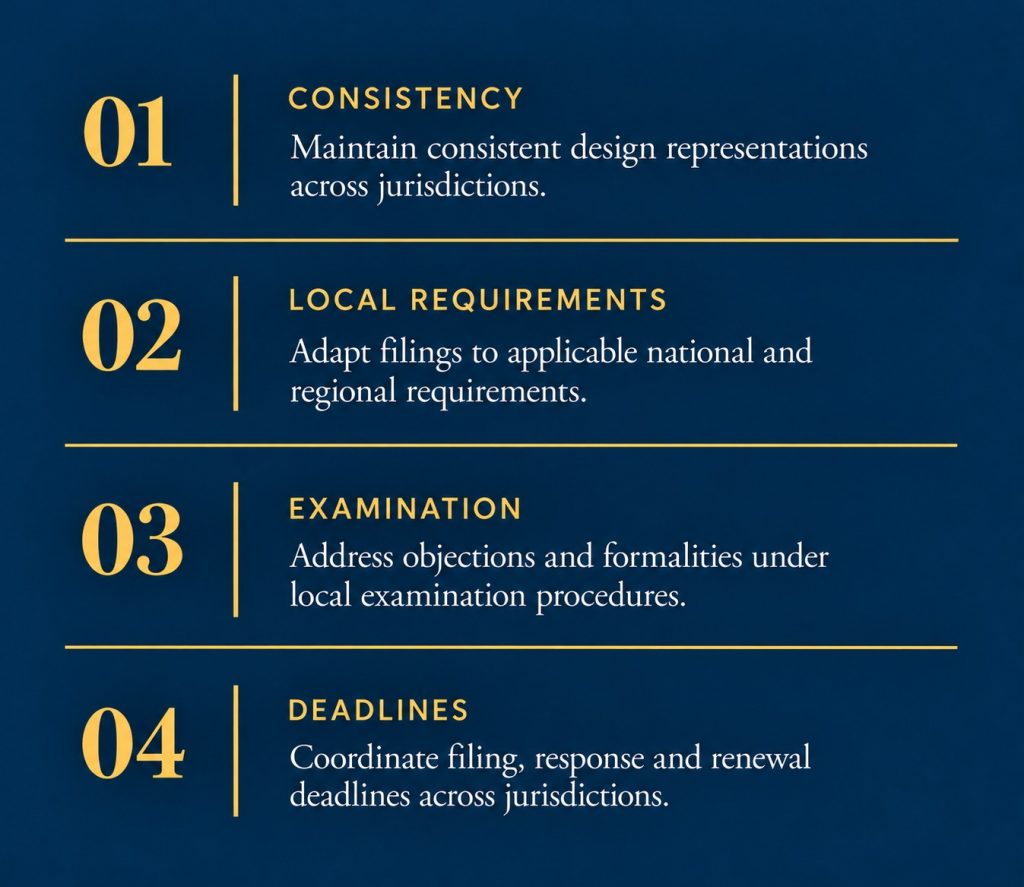
COORDINATING REGISTRATIONS
One Design. Different Requirements.
International filings must remain aligned despite differences in local requirements, examination practices and deadlines.
Different systems. One coordinated strategy.
FROM REGISTRATION TO PORTFOLIO
Registration Is the Beginning
“International design portfolios must evolve with the business. As markets, ownership and commercial priorities change, protection should remain current and commercially relevant.
Registration secures the right. Portfolio strategy preserves its value.
01 RENEWALS
Maintain Protection
Keep registrations in force where protection remains commercially relevant
02 OWNERSHIP
Keep Title Current
Record assignments and ownership changes across relevant jurisdictions.
03 EXPANSION
Extend the Portfolio
Extend protection as new designs, variants and markets emerge.
04 COMMERCIAL USE
Turn Rights Into Value
Support licensing, collaboration and other commercial opportunities involving protected designs.
Frequently Asked, Clearly Answered
01. Can one application protect a design in multiple countries?
Yes. Where the relevant jurisdictions participate in the Hague System, a single international application can designate multiple markets. Separate national or regional filings may be required elsewhere.
02. Do I need an existing design registration before filing internationally?
03. Can multiple designs be included in one international application?
Potentially. A Hague application may include up to 100 designs, provided they fall within the same class of the Locarno Classification. Individual jurisdictions may, however, apply their own unity-of-design requirements.
04. Can priority be claimed from an earlier design application?
Yes. Priority may generally be claimed from an earlier qualifying application where the international application is filed within six months of the first filing. The priority claim must be made when the international application is filed.
05. Does an international registration guarantee protection in every designated country?
Not automatically. Each designated jurisdiction may examine the design under its own domestic law and may issue a refusal. A refusal in one jurisdiction does not affect protection in the others.
06. How long does international design protection last?
An international registration begins with a five-year term and can be renewed. The Hague System guarantees the possibility of at least 15 years of protection, while some jurisdictions allow protection for longer periods under their domestic laws.
Protect What Moves With Your Business
As designs enter new markets, protection should move with them. We structure international registration strategies around the jurisdictions that matter to your business.