
DOMAIN DISPUTES & RECOVERY
Resolve Domain Disputes. Reclaim Your Rights.
We advise on domain ownership conflicts, bad-faith registrations and recovery proceedings to protect brand rights and restore control over disputed domains.
THE STRATEGIC CONTEXT
When Domain Ownership Becomes a Dispute.
Establish the rights. Define the remedy.
Unauthorised registrations, cybersquatting and conflicting domain claims can threaten brand identity and commercial interests. Effective resolution begins with assessing ownership rights, supporting evidence and available recovery options.
OUR APPROACH
From Dispute to Resolution.
We assess competing domain claims, establish the grounds for action and pursue the most appropriate route to resolution or recovery.
01
RIGHTS ASSESSMENT
Examine trademark rights, domain ownership and the basis of the dispute.
02
EVIDENCE REVIEW
Assess registration history, domain use and indications of bad faith.
03
DISPUTE STRATEGY
Determine the appropriate route through negotiation, UDRP or applicable dispute procedures.
04
RECOVERY & TRANSFER
Pursue domain cancellation or transfer where supported by the relevant rules and evidence.
Clear grounds. Focused action. Effective resolution.
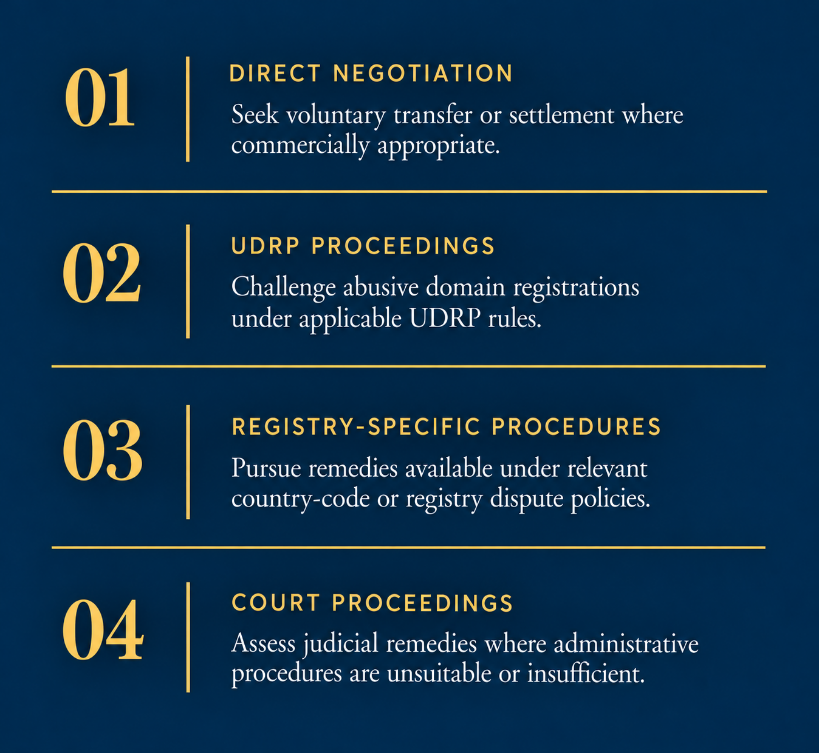
DOMAIN DISPUTE RESOLUTION
The Right Route to Resolution
Not every domain dispute requires formal proceedings. We assess the available remedies and identify the most appropriate route based on the rights, evidence and desired outcome.
The appropriate remedy. The clearest path forward.
EVIDENCE & CASE PREPARATION
Build the Case on Clear Grounds.
Effective domain recovery depends on credible evidence. We examine prior rights, registration records and indications of bad faith to establish a well-supported claim.
PRIOR RIGHTS
Document trademark rights, earlier use and recognised brand interests
REGISTRATION HISTORY
Examine registration dates, ownership records and relevant changes.
BAD-FAITH INDICATORS
Identify impersonation, misleading use and evidence of abusive registration or use.
SUPPORTING EVIDENCE
Document the facts. Substantiate the claim.
Document the facts. Substantiate the claim.
DOMAIN RECOVERY & TRANSFER
From Resolution to Restored Control.
A favourable decision is only the beginning. We coordinate the necessary procedures with registrars to implement domain recovery or transfer and restore control to the entitled holder.
From decision to effective control.
POST-RECOVERY PROTECTION
Secure the Domain. Protect Its Future.
Domain recovery should lead to lasting control. We strengthen ownership security, address vulnerabilities and reduce exposure to future disputes.
Restore control. Maintain protection.
01 INCONSISTENT VIEWS
OWNERSHIP SECURITY
Verify registration details, access controls and renewal arrangements.
02 UNNECESSARY DETAIL
DEFENSIVE COVERAGE
Identify related domains that warrant protective registration.
03 UNCLEAR BOUNDARIES
ONGOING MONITORING
Monitor potentially conflicting registrations and emerging risks.
Frequently Asked, Clearly Answered
01. What constitutes a domain name dispute?
A dispute arises when a domain registration or use conflicts with another party’s trademark rights or legitimate interests.
02. Can I recover a domain registered by someone else?
Potentially. Recovery depends on your rights, the circumstances of registration and the applicable dispute resolution rules.
03. What is the UDRP?
The Uniform Domain Name Dispute Resolution Policy (UDRP) provides an administrative procedure for challenging certain abusive domain registrations.
04. Is trademark registration required to file a domain dispute?
Not always. Established unregistered trademark rights may also support a claim, subject to the applicable rules.
05. How long does domain recovery take?
Timelines vary by procedure and case complexity. An uncontested UDRP proceeding typically takes around two months.
06. Can a disputed domain be transferred without formal proceedings?
Yes. Voluntary transfer or negotiated settlement may resolve a dispute without formal proceedings.
07. What happens if a domain dispute is successful?
Depending on the procedure and remedy requested, the domain may be transferred or cancelled, subject to applicable implementation requirements.
Reclaim What Belongs to Your Brand.
Resolve domain conflicts with a clear strategy, established rights and focused recovery action.