
CEASE & DESIST LETTERS AND INFRINGEMENT NOTICES
Address Infringement. Assert Your Rights.
Strategically drafted cease and desist letters and infringement notices to challenge unauthorised use, demand corrective action and protect your intellectual property rights.
THE ENFORCEMENT PERSPECTIVE
A Formal Notice. A Strategic First Step.
Assert your rights. Demand action. Define the next step
A cease and desist letter formally asserts intellectual property rights, identifies alleged infringement and demands corrective action, often providing an opportunity to resolve disputes before litigation.
ASSESSING THE INFRINGEMENT
Establish the Facts Before Taking Action.
We assess intellectual property rights, alleged infringement and supporting evidence to establish the legal grounds, appropriate demands and strategy for an effective infringement notice.
01
IP RIGHTS REVIEW
Verify ownership, registration status and the scope of enforceable rights.
02
INFRINGEMENT ASSESSMENT
Examine the alleged violation and its relevance to the protected rights.
03
EVIDENCE REVIEW
04
NOTICE STRATEGY
Define the grounds, demands and appropriate course of action.
Clear evidence. Defined rights. Targeted action.
DRAFTING THE FORMAL NOTICE
Every Word. A Defined Purpose.
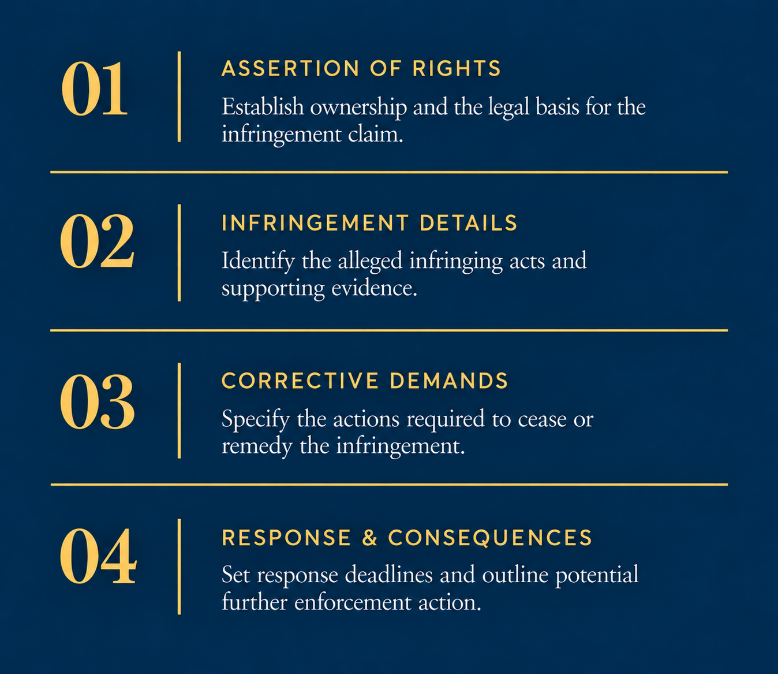
A cease and desist letter must be precise, substantiated and proportionate. We draft formal infringement notices that clearly assert IP rights, identify the alleged violation and specify the action required.
Precise in language. Firm in position. Measured in approach.
NOTICE DELIVERY & RESPONSE MANAGEMENT
From Formal Notice to Meaningful Action.
Effective enforcement extends beyond issuing a cease and desist letter. We coordinate notice delivery, assess responses and monitor compliance to determine whether the infringement has been resolved or further action is warranted.
NOTICE DELIVERY
Coordinate delivery of infringement notices and maintain supporting records
RESPONSE REVIEW
Evaluate replies, objections, settlement proposals and proposed undertakings
COMPLIANCE MONITORING
Assess whether infringing activities have ceased and corrective demands have been addressed
FURTHER ACTION
Identify unresolved issues and advise on appropriate enforcement measures
Delivery establishes the demand. Follow-through determines the outcome.
RESOLUTION & ENFORCEMENT OPTIONS
Resolve Where Possible. Escalate Where Necessary.
We prioritise voluntary compliance, negotiated undertakings and settlement, pursuing formal enforcement where resolution cannot be achieved.
ESCALATION
Resolution where achievable. Enforcement where required.
STRATEGIC ENFORCEMENT OUTLOOK
Beyond the Notice. Protecting What Comes Next.
We assess recurring infringement risks, compliance gaps and future exposure to identify measures that strengthen long-term intellectual property protection.
Address Today’s Infringement. Anticipate Tomorrow’s Risks
01 REPEAT INFRINGEMENT
Identify risks of recurring or continued unauthorised use.
02 ONGOING COMPLIANCE
Assess adherence to agreed undertakings and corrective measures.
03 FUTURE EXPOSURE
Assess related products, markets and channels vulnerable to infringement.
04 PROTECTIVE MEASURES
Recommend targeted monitoring and preventive enforcement steps.
Frequently Asked, Clearly Answered
01. What is a cease and desist letter?
A cease and desist letter is a formal demand requesting a party to stop activities that allegedly infringe intellectual property rights and take specified corrective action.
02. When should an infringement notice be issued?
An infringement notice may be appropriate when credible evidence indicates unauthorised use of a trademark, copyright or other protected intellectual property.
03. Is a cease and desist letter legally binding?
A cease and desist letter is generally not a court order. However, it formally communicates infringement allegations and demands, and may support subsequent enforcement proceedings.
04. What should a cease and desist letter include?
It should identify the IP rights, alleged infringement, supporting grounds, corrective demands, response deadline and potential consequences of non-compliance.
05. What happens if a cease and desist letter is ignored?
Further action may include follow-up demands, settlement negotiations, administrative complaints or judicial proceedings, depending on the circumstances and jurisdiction.
06. Can infringement disputes be resolved without litigation?
Yes. Many disputes can be addressed through voluntary compliance, negotiated undertakings or settlement agreements without court proceedings.
07. Can a cease and desist letter be sent for online infringement?
Yes. Formal notices can address unauthorised trademark use, copyright infringement, misleading online listings and other infringing digital activities.
08. Can a cease and desist letter be challenged?
Yes. The recipient may dispute the asserted rights, infringement allegations or demands. Each response should be assessed against the evidence and applicable law.
09. Can cease and desist letters be issued internationally?
Yes. Notices may be directed to parties in other jurisdictions, subject to applicable local laws, IP rights and enforcement procedures.
10. What evidence is needed before issuing an infringement notice?
Relevant evidence may include IP registration records, screenshots, product samples, advertisements, transaction records and documentation of the alleged infringement.
Assert Your Rights. Demand Action.
Address IP infringement with strategically drafted cease and desist letters and infringement notices that assert your rights, demand corrective action and support effective resolution.