
FROM DESIGN TO PROTECTION
Prepare the Design. Define the Protection.
A design application is shaped by how the design is presented. We prepare clear, consistent and filing-ready applications that define the design intended for protection.
PRECISION BEFORE FILING
A Strong Application Starts With How the Design Is Presented.
Precision at filing creates clarity in protection.
Design protection is defined not only by the product itself, but by what the application shows and how clearly it shows it.
Representations, descriptions and filing details should work together to identify the design consistently and leave no unnecessary ambiguity around the protection sought.
DEFINING THE APPLICATION
Protect What Is Intended. Exclude What Is Not.
A design application must clearly define the protection sought. Every element should be assessed for what it includes and what it excludes.
THE DESIGN
Identify the visual features intended for protection and ensure they are accurately represented.
PRODUCT INDICATION
Describe and classify the product to which the design is applied, in line with filing requirements.
REPRESENTATIONS
Select clear, consistent views that accurately show the design from the required perspectives.
DISCLAIMERS
Distinguish claimed features from elements excluded from protection, where permitted.
The objective is not wider protection. It is protection in the right places.
PREPARING THE REPRESENTATIONS
Show the Design Clearly.
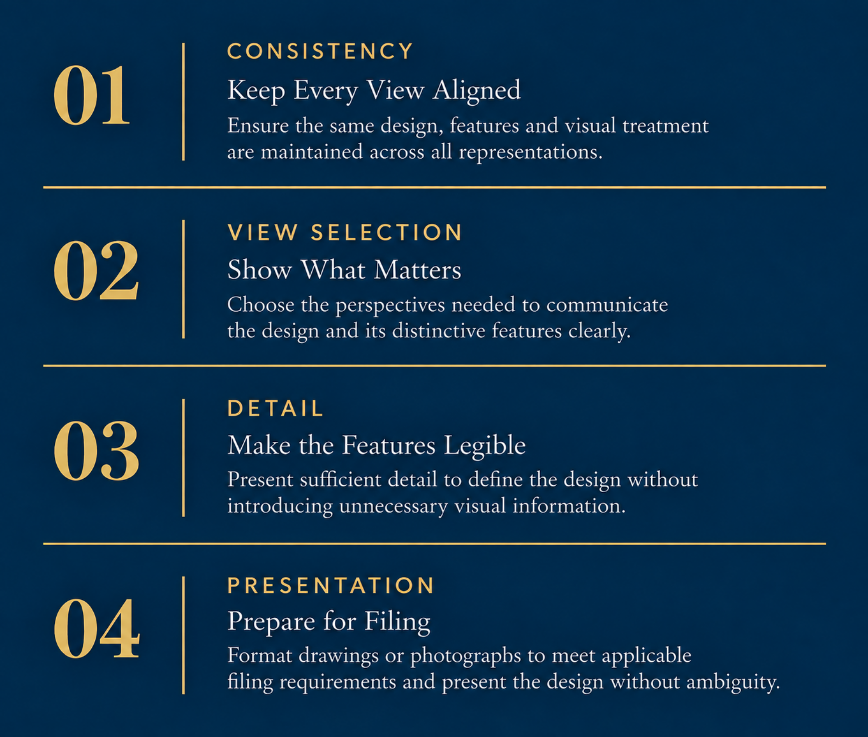
Every representation must contribute to a clear, consistent and complete presentation of the design. Together, the views should define the features intended for protection.
Clarity in representation strengthens certainty in protection.
BUILDING THE FILING PACKAGE
From Design to Filing-Ready Application.
A complete application brings the design, its representations and the required filing information together in one coherent record. Each element is checked before submission.
Precision before submission reduces avoidable objections.
MANAGING VARIANTS & MULTIPLE DESIGNS
One Design or a Wider Filing Strategy?
Variants, configurations and related designs require a filing strategy that protects what matters without unnecessary filings.
VARIANTS
Identify Meaningful Differences
Assess whether changes in shape, configuration or appearance justify separate protection.
RELATED DESIGNS
Consider What Belongs Together
Evaluate relationships between designs and their eligibility for combined filing.
MULTIPLE DESIGNS
Structure the Application
Determine whether designs can be included in one application or require separate filings.
FILING SCOPE
Protect the Right Versions
Prioritise designs and configurations with genuine commercial or strategic value.
The objective is not to file every variation. It is to protect the variations that matter.
AVOIDING APPLICATION WEAKNESSES
Small Errors Can Narrow the Result.
Design applications depend on precision. Inconsistencies or unnecessary detail can create ambiguity around what is being protected.
Precision before filing reduces uncertainty after it.
01 INCONSISTENT VIEWS
Keep the Design Aligned
Ensure every representation shows the same design without conflicting features or proportions.
02 UNNECESSARY DETAIL
Show Only What Matters
Avoid visual information that may unintentionally affect the scope or clarity of the design.
03 UNCLEAR BOUNDARIES
Define the Protection
Distinguish clearly between features intended for protection and those that are not.
04 PRODUCT IDENTIFICATION
Classify With Care
Describe and classify the product accurately in line with applicable filing requirements.
Frequently Asked, Clearly Answered
01. What is required for a design registration application?
Requirements vary by jurisdiction, but typically include clear representations of the design, product identification, applicant and designer details, classification information and any required priority or supporting documents.
02. Why are design representations important?
The representations define how the design is presented in the application and can directly influence the scope and clarity of the resulting protection. They should be accurate, consistent and free from unnecessary ambiguity.
03. How many views of a design should be included?
The number depends on the design and applicable filing rules. Front, rear, side, top, bottom and perspective views may be used where necessary to show the design clearly and consistently.
04. Can photographs be used instead of drawings?
In many jurisdictions, photographs may be accepted, subject to specific requirements. The appropriate format depends on the design, filing strategy and rules of the relevant design office.
05. Can multiple designs be included in one application?
Certain jurisdictions permit multiple designs within a single application, subject to conditions such as product classification or other filing requirements. Related designs should be assessed before deciding whether to file together or separately.
06. How are design variants handled?
Variants should be reviewed to determine whether their visual differences justify separate protection or whether they can be included within a broader filing approach, subject to applicable rules.
07. Can parts of a product be excluded from the design claim?
Where permitted, visual disclaimers or other representation techniques may be used to distinguish features intended for protection from those that are not claimed.
08. What can weaken a design registration application?
Common issues include inconsistent views, unclear representations, unnecessary detail, incorrect product identification and inconsistencies between the representations and application information.
09. Can a design application be amended after filing?
Amendments may be possible, but the extent of permissible changes is often restricted and varies by jurisdiction. Preparing the application correctly before filing helps reduce reliance on later amendments.
10. Why use professional design application preparation?
A professionally prepared application brings the representations, filing information and protection sought into alignment, helping reduce avoidable formal objections and uncertainty over the design submitted for registration.
PREPARE WITH PRECISION
Turn Your Design Into a Filing-Ready Application. TEXT: Clear representations. Precise details. A professionally prepared application built for effective design protection.