
STRATEGISE. MANAGE. COMMERCIALISE
From Patent Rights to Commercial Value
Align patent assets with business priorities, manage them across their lifecycle and unlock opportunities for commercial value.
BEYOND REGISTRATION
A Patent Portfolio Should Serve the Business
Portfolio management connects what is protected with where the business is going.
Patents should not sit apart from the business. Each asset should support a technology, market, commercial opportunity or strategic priority.
PORTFOLIO REVIEW
Not Every Patent Carries the Same Value.
A portfolio should be reviewed against the technologies, markets and business priorities it is meant to support.
01
RELEVANCE
Connect to the Business
Assess how each patent supports current technologies, products and strategic priorities.
02
COVERAGE
Map the Protection
Identify where the portfolio provides meaningful protection—and where gaps remain.
03
VALUE
Recognise the Opportunity
Consider the commercial, licensing and strategic potential of individual assets.
04
PRIORITY
Focus the Portfolio
A stronger portfolio is not necessarily a larger one. It is one built around assets that matter.
ACROSS THE LIFECYCLE
Protect the Value. Manage the Commitment.
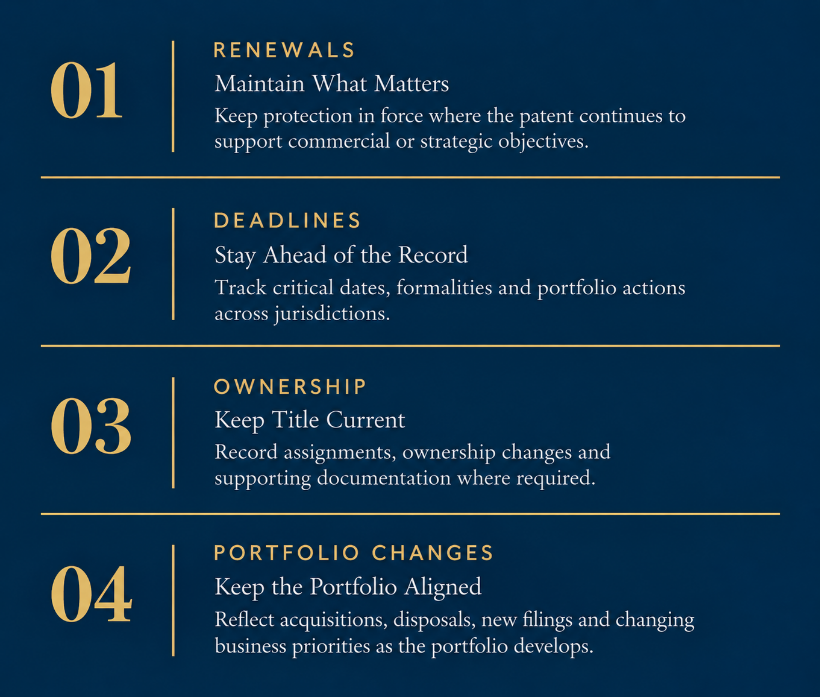
Patent portfolios require decisions long after filing. Renewals, ownership changes, deadlines and portfolio developments should be managed against the continuing value of each asset.
A portfolio stays valuable when its protection, records and business purpose stay aligned.
PORTFOLIO DIRECTION
Portfolios Should Evolve with the Business.
Portfolio strategy is not about accumulating patents. It is about maintaining the right protection as the business moves forward.
FROM PROTECTION TO VALUE
Patent Rights Can Create Commercial Opportunity.
A patent can do more than protect a market position. It can support licensing, collaboration, investment and other routes to commercial value.
Commercialisation begins by understanding what the patent can enable—not simply what it protects.
01 LICENSING
Open New Revenue Paths
Use patent rights to create licensing opportunities without transferring ownership.
02 COLLABORATION
Enable Strategic Partnerships
Use protected technology as a foundation for commercial or technical collaboration.
03 TRANSACTIONS
Unlock Asset Value
Position patent rights for assignment, acquisition or other strategic transactions.
04 INVESTMENT
Strengthen the Proposition
Use a considered patent position to support investment, growth and commercial negotiations.
ASSESSING THE OPPORTUNITY
Not Every Patent Is Ready to Commercialise.
Commercial potential depends on more than ownership. The strength of the right, market relevance and the opportunity for exploitation should be considered together.
RIGHTS
Know What Is Controlled
MARKET
Identify the Opportunity
Consider where the protected technology addresses a commercial need or market opportunity.
FIT
Find the Right Route
Determine whether licensing, collaboration, assignment or another structure best serves the objective.
VALUE
Define the Commercial Case
Consider the strategic and economic value the patent may bring to a transaction or relationship.
The right commercial route begins with a clear view of the asset and the opportunity.
STRUCTURING THE DEAL
Commercial Value Depends on the Terms.
A strong patent position creates opportunity. The agreement determines how that opportunity is shared, controlled and monetised.
01
RIGHTS GRANTED
Define the Permission
Set the scope of use, including technology, products, territory and permitted activities.
02
COMMERCIAL TERMS
Structure the Return
Define royalties, fees, milestones or other consideration around the commercial model.
03
CONTROL
Set the Boundaries
Address exclusivity, sublicensing, improvements and other limits on exploitation.
04
PERFORMANCE
Protect the Opportunity
A well-structured agreement turns patent rights into defined commercial rights, obligations and returns.
A well-structured agreement turns patent rights into defined commercial rights, obligations and returns
Frequently Asked, Clearly Answered
01. What is patent portfolio management?
02. How often should a patent portfolio be reviewed?
Review should be ongoing, with more focused assessment around renewals, new filings, transactions, market changes and shifts in business strategy.
03. Should every patent in a portfolio be maintained?
Not necessarily. Continued protection should be considered against the patent’s relevance, cost, commercial potential and place within the wider portfolio.
04. How can patents be commercialised?
Depending on the rights and commercial objective, patents may support licensing, assignments, collaborations and other technology-based transactions.
05. What should be considered before licensing a patent?
Key considerations include ownership, scope and status of the rights, territory, exclusivity, permitted use, financial terms, sublicensing and future flexibility.
06. Can patent rights be licensed without transferring ownership?
Yes. A licence can permit defined use of patent rights while ownership remains with the patent holder, subject to the agreed terms.
07. Can patents be sold or transferred?
Yes. Patent rights may generally be assigned or transferred, subject to applicable law, contractual requirements and any necessary recordals.
08. How does commercialisation affect the wider patent portfolio?
A transaction can affect retained rights, market coverage and future opportunities. Its terms should therefore be considered in the context of the wider portfolio and business strategy.
Put Your Patent Portfolio to Work.
Align protection with business priorities, manage what matters and pursue the commercial opportunities your patent assets can support.