
WHAT CAME BEFORE
Prior Art Search
Every invention enters an existing technical landscape. A focused prior art search reveals what came before and what may stand in the way of protection.
THE EXISTING LANDSCAPE
Innovation Does Not Start from Zero.
Prior art reveals the technical landscape before protection is pursued.
Earlier patents, publications and technical disclosures can shape what remains open to protection.
BEYOND PATENT RECORDS
Prior Art Can Surface Anywhere.
Relevant prior art is not limited to patent records. A search may extend across patent and non-patent sources wherever earlier technical disclosure may exist.
01
PATENT DOCUMENTS
Granted patents and published patent applications across relevant jurisdictions.
02
SCIENTIFIC & TECHNICAL LITERATURE
Research papers, journals, conference materials and technical publications.
03
PRODUCTS & TECHNOLOGIES
Existing products, systems and technical solutions already available to the public.
04
PUBLIC DISCLOSURES
FROM SEARCH TO RELEVANCE
Not Every Result Matters.
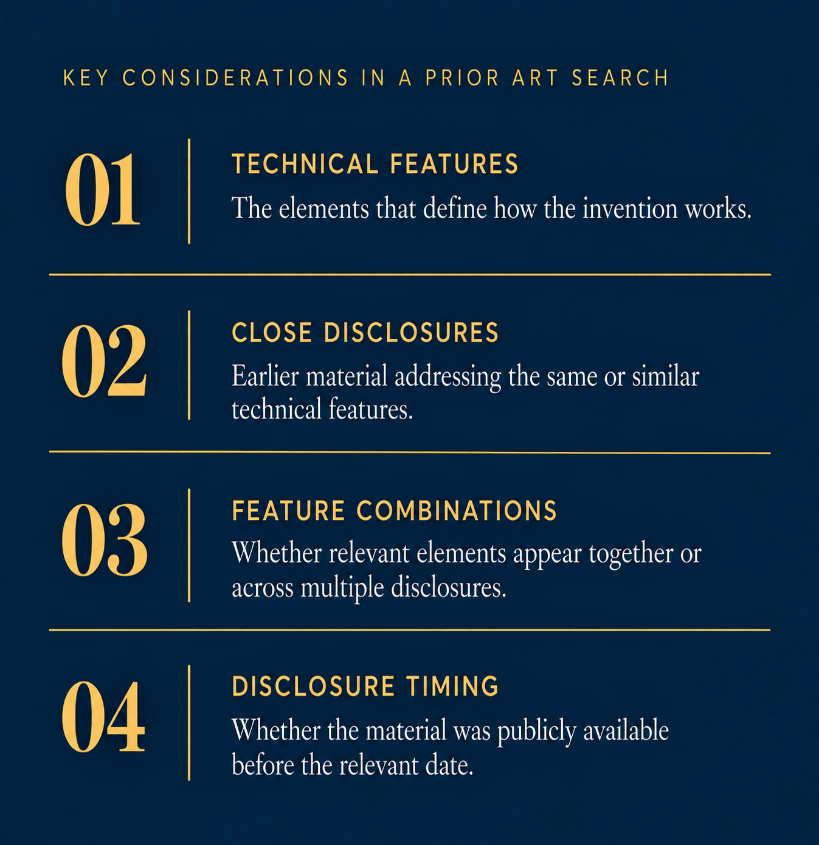
A prior art search is not measured by the volume of material found, but by the relevance of what it reveals. The focus is on disclosures that intersect with the invention’s defining technical features.
The objective is not simply to find prior art, but to identify the prior art that matters.
FROM FINDINGS TO POSITION
What the Search Reveals.
A prior art search moves from identifying relevant disclosures to understanding where the invention stands.
TURN INSIGHTS INTO STRATEGY
Search First. Draft with Perspective.
What is known before filing can shape what is pursued in the application.
01 DRAFTING FOCUS
02 CLAIM DIRECTION
03 FILING DECISIONS
Provide a stronger basis for deciding whether and how to proceed.
04 EARLY RISK AWARENESS
Frequently Asked, Clearly Answered
01. Is a prior art search the same as a patentability assessment?
02. When should a prior art search be conducted?
03. Does prior art include only patents?
No. Relevant prior art may include patent publications, technical literature, products and other information made available to the public.
04. Can a prior art search guarantee that an invention is new?
No. A search can identify relevant disclosures within its scope, but it cannot establish that every potentially relevant disclosure has been found.
05. Can prior art from another country affect a patent application?
Potentially, yes. Publicly available disclosures may be relevant regardless of where they originated, subject to the applicable patent framework and relevant dates.
06. What information is needed to conduct a prior art search?
Know What Came Before.
Understand the existing technical landscape before committing to the next stage of protection.