
CREATIVE RIGHTS WITHOUT BORDERS
International Copyright Strategy
Creative works travel across borders. Their protection demands a strategy that does the same.
BEYOND NATIONAL BORDERS
Copyright is Territorial. Creativity is Global.
International protection begins with knowing where rights matter most.
Creative works cross borders with ease. Copyright protection does not. Each jurisdiction brings its own rules, requirements and considerations.
STRATEGIC FRAMEWORK
Protection Shaped Around Where Rights Matter.
Copyright protection is territorial, but creative works increasingly move across markets, platforms and jurisdictions.
An international strategy identifies where protection, registration and enforcement should be prioritised.

STRATEGIC PRIORITIES
What Shapes an International Copyright Strategy
International protection is shaped by where works are created, used, commercialised and most exposed to risk.
01
MARKETS
Where protection has the greatest commercial significance.
02
OWNERSHIP
How rights are held and recognised across jurisdictions.
03
COMMERCIAL USE
Where works are licensed, distributed or exploited.
04
FORMALITIES
Where registration or recordal strengthens protection.
05
ENFORCEMENT
Where infringement risk requires greater attention.
06
PORTFOLIO PRIORITIES
Where investment in protection delivers the greatest strategic value.
JURISDICTIONAL APPROACH
Protection Changes Across Borders
Copyright principles may travel internationally, but their application remains shaped by local law.
CROSS-BORDER COORDINATION
Connecting Protection Across Markets
International copyright strategy brings separate jurisdictions into a coordinated framework for protecting and managing creative rights.
Priority Markets
Where protection matters most.
Rights Position
What is owned and by whom.
Commercial Reach
Where works are used and monetised.
Risk Exposure
Where protection or enforcement requires attention.
FROM STRATEGY TO ACTION
International Protection in Practice
Protection is strongest when international direction is matched by the right local action.
COMMERCIAL ALIGNMENT
Protection That Follows the Opportunity
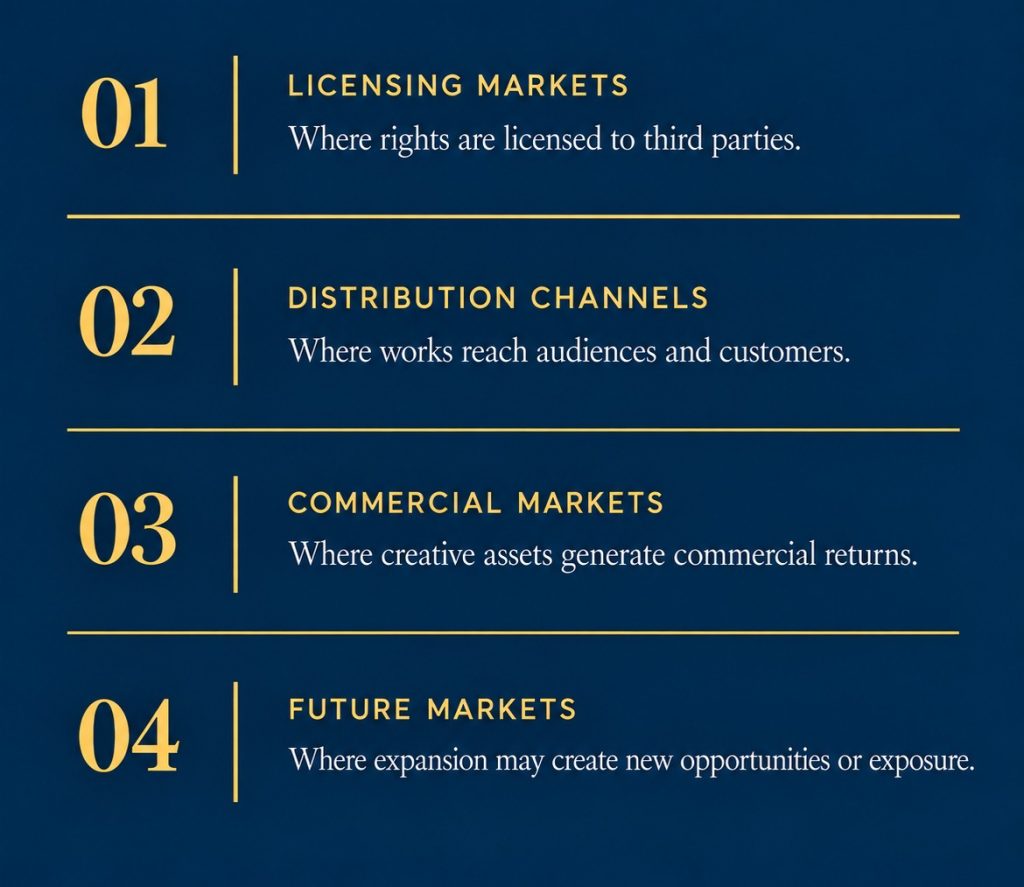
International copyright protection should reflect where creative works are distributed, licensed and commercially exploited.
LICENSING MARKETS
Where rights are licensed to third parties.
DISTRIBUTION CHANNELS
Where works reach audiences and customers.
COMMERCIAL MARKETS
Where creative assets generate commercial returns.
FUTURE MARKETS
Where expansion may create new opportunities or exposure.
Frequently Asked, Clearly Answered
01. Is copyright protection international?
Copyright protection remains territorial, although international treaties provide frameworks through which works may receive protection across participating countries. The scope and enforcement of rights remain subject to applicable national laws.
02. Do I need to register copyright in every country?
Not necessarily. Registration requirements and benefits vary between jurisdictions. An international strategy identifies where registration or other formalities provide meaningful legal or commercial value.
03. How do I decide which countries should be prioritised?
Priority is generally determined by where works are created, distributed, licensed or commercially valuable, as well as markets where infringement or future expansion is relevant.
04. Can one copyright strategy cover multiple types of creative works?
Yes. A coordinated strategy can address different categories of works, including literary, artistic, audiovisual, musical, photographic and digital works, while accounting for differences in ownership, use and protection.
05. How do international treaties affect copyright protection?
International copyright treaties establish principles for recognising and protecting works between participating countries. Their practical application, however, depends on the domestic laws of each jurisdiction.
06. Can copyright ownership differ between countries?
A COORDINATED VIEW
International strategy brings individual works, markets and rights together within a coherent portfolio approach.